

Introduction — Understanding the “Diddy Mansion Sale Stigma”
In the glittering world of American celebrity culture, few stories capture attention quite like the mystery surrounding Diddy mansion sale stigma. The name “Diddy,” officially known as Sean Combs, has always represented luxury, influence, and controversy. When rumors surfaced about his mansion being “stigmatized,” the news didn’t just stay within gossip headlines — it rippled across the global real-estate community, sparking serious discussions about reputation, property value, and celebrity influence.
What Does “Mansion Sale Stigma” Really Mean?
In real-estate terms, a stigma refers to a hidden factor that negatively affects a property’s market perception — even when the building itself is flawless. This could be anything from scandals, rumors, past ownership controversies, or neighborhood speculation. In Diddy’s case, the term “mansion sale stigma” arose after his high-profile lifestyle, legal issues, and media controversies began influencing how buyers viewed his properties.
The mansion itself remained architecturally stunning — featuring lavish design, custom interiors, and state-of-the-art facilities — yet the market sentiment surrounding it changed. This demonstrates how public image can directly impact real-estate value, especially in the celebrity home sector.
Why This Topic Matters for Global Readers (Including South Korea)
In South Korea, where interest in luxury real estate, pop culture, and celebrity lifestyles is rapidly growing, Diddy’s story offers a meaningful case study. It shows how personal branding, social reputation, and property economics intertwine — lessons that apply not only in the U.S. but also in emerging real-estate markets like Seoul, Busan, and Incheon.
The Diddy mansion sale stigma highlights the importance of:
- Public trust in real-estate transactions
- Digital reputation management
- Cultural sensitivity in luxury property marketing
Understanding this helps readers, investors, and agents learn how perception shapes demand — a universal concept in global property markets.
Background: Diddy’s Real-Estate Legacy
Over the past two decades, Diddy built an empire not just through music and business ventures, but also through luxury real-estate investments. His mansions in Los Angeles, Miami, and New York were symbols of wealth and style. However, when controversies surrounded his personal life, the value perception of these estates began shifting.
For buyers, Diddy’s name carried both prestige and pressure. For the market, it meant volatility — making his properties both attractive and complicated.
Real-Estate and Reputation: The Core Connection
Google’s algorithm now prioritizes experience and trustworthiness in content (E-E-A-T). The same principles apply in real estate.
When a property is connected to a public figure:
- Search visibility increases
- Curiosity drives traffic
- But controversy can lower buyer confidence
In Diddy’s case, online discussions about lawsuits, lifestyle rumors, and social debates created an invisible tag on his mansion — the stigma. Even potential buyers who admired him began questioning whether purchasing such a home might invite unwanted attention.
This shows that “brand impact” isn’t limited to products — it extends to properties too.
The Real Reasons Behind the Diddy Mansion Sale Stigma
When news first broke that Sean “Diddy” Combs was putting one of his prized mansions on the market, the reaction across America was mixed — admiration, curiosity, and a wave of skepticism. But behind every major sale in the celebrity world, there’s a story that goes deeper than luxury furniture and marble floors.
The “Diddy Mansion Sale Stigma” isn’t just about a property listing — it’s a reflection of how fame, reputation, and public perception can reshape an entire business transaction.
The Mansion That Defined a Lifestyle
Diddy’s mansion was more than a house. It symbolized a chapter of his success — the kind of property that made headlines for its elegance, massive swimming pool, private recording studio, and grand views of Los Angeles. Built with both modern luxury and classic American design, it was a representation of status and ambition.
However, when the mansion went up for sale, conversations quickly shifted from architecture to the aura surrounding its owner. Buyers weren’t just evaluating rooms — they were evaluating what the name “Diddy” carried into the property.
Media Speculation and Market Reaction
The moment the mansion sale hit public listings, the media narrative took control. News outlets began linking the property to Diddy’s ongoing legal controversies, social rumors, and lifestyle headlines. In the U.S. celebrity market, media coverage can either elevate or stigmatize a property — and in this case, it did both.
The headlines created intrigue, but they also seeded hesitation among buyers. Many started to question whether owning a property associated with a celebrity involved in controversy might bring unwanted public attention.
This effect wasn’t just limited to Diddy’s home — it exposed how celebrity branding can influence real estate psychology in the United States.
The Psychological Impact on Buyers
For high-end buyers, luxury homes represent identity. People invest not only in comfort but in what the house says about their social image. When a mansion becomes connected with scandal or public debate, it triggers emotional caution.
Even in the absence of factual issues, buyer hesitation grows because of social associations.
This phenomenon is known as a “reputational ripple” — where a famous owner’s image becomes inseparable from the house’s perceived energy.
Some potential buyers might even feel superstitious, believing that properties “carry” the emotional energy of their previous owners. Others simply fear public judgment or unwanted media exposure.
Thus, the “Diddy Mansion Sale Stigma” became not just a real estate event — but a social case study on how modern buyers react to celebrity-linked assets.
Real Estate Agents’ Challenge
Agents involved in luxury celebrity homes often face a dilemma: how to market a famous property without overemphasizing the fame itself. In Diddy’s case, even the most professional agents knew the challenge would be balancing transparency with exclusivity.
The mansion’s value on paper remained high. But its emotional value — the way people felt about buying it — was uncertain. For real estate professionals, the stigma turned into a practical business problem:
how do you sell perfection when perception is broken?
Hidden Factors Behind the Stigma
- Public Controversies:
Repeated headlines about Diddy’s legal and personal life created long-term public doubt. Even after clarification or denials, the initial impression stayed. - Overexposure:
The mansion had been featured in interviews, photoshoots, and documentaries. Buyers seeking privacy saw that as a disadvantage. - Cultural Sensitivity:
In the U.S., especially in high-profile markets like Beverly Hills, social image holds major value. A property linked to controversy can drop in appeal, even if structurally flawless. - Speculation by Investors:
Some investors saw the stigma as an opportunity to negotiate lower prices — proof that reputation can alter market math. - Media Echo Effect:
The longer the topic stayed in public conversation, the deeper the stigma became. Search results, social media chatter, and gossip pages amplified the issue far beyond the actual facts.
The Result — A House with Two Stories
By the time serious buyers came to view the mansion, the property had become symbolic of two worlds:
- One, the stunning physical beauty — high ceilings, artistic interiors, panoramic landscapes.
- The other, an invisible shadow of public opinion and personal drama.
This duality defined the “Diddy Mansion Sale Stigma.”
Even when the mansion itself had no flaws, the story around it made people hesitate.
For many observers in the U.S., it became a cultural moment — a sign that image can influence economics, and that even the richest names in entertainment aren’t immune to market psychology.
The Hidden Truths — Inside Diddy’s Decision, Market Movements, and Real Reactions
Behind every celebrity mansion sale, there’s always more than meets the eye.
In Diddy’s case, what seemed like a simple property listing was actually the result of a combination of timing, image control, and emotional fatigue.
The “Diddy Mansion Sale Stigma” wasn’t born overnight — it was built slowly through layers of events, rumors, and emotional weight.
The Emotional Side of a Public Sale
For a man who had built his empire through ambition, creativity, and unmatched drive, selling one of his iconic homes wasn’t just a financial decision.
It was deeply personal.
Diddy’s mansions weren’t investments in the traditional sense — they were reflections of identity. They represented success, freedom, and the American dream realized.
However, when public controversy grew louder, those same walls began to carry the echoes of stress, headlines, and emotional tension.
The truth is that luxury doesn’t protect anyone from public pressure. Even billion-dollar properties can feel heavy when their stories are tangled with media narratives.
The Market Behind the Move
The American luxury housing market works in cycles.
When the “Diddy Mansion Sale” entered listing platforms, analysts noticed something interesting — similar high-profile homes in California, Miami, and New York were also facing longer listing times.
This suggested that the stigma wasn’t only personal — it also aligned with a shift in market psychology.
Buyers in 2025 and beyond began prioritizing discreet luxury over public fame. Quiet wealth replaced loud glamour.
So, while Diddy’s name brought global recognition, it also represented the kind of visibility that modern ultra-rich buyers were starting to avoid.
Media Noise vs. Market Reality
The American media ecosystem thrives on narratives — and Diddy has always been a magnet for attention.
When his mansion hit the market, multiple stories emerged simultaneously:
- Some claimed he was restructuring his portfolio.
- Others assumed he was trying to escape bad publicity.
- A few even framed it as an emotional cleansing — a symbolic “fresh start.”
The reality, however, seemed to combine all three.
It’s possible Diddy wanted to reset his physical environment, refocus his energy, and reposition his assets during a time of heightened public visibility.
Unfortunately, in the U.S., such actions rarely go unnoticed — every move becomes a headline.
As a result, the mansion sale turned into a cultural event, blurring the line between business and personal life.
Real Reactions from Buyers and Agents
In private circles of high-end real estate, people began whispering about the “energy” of the house. Some agents described buyers feeling “uncomfortable” or “unsure” during tours.
Not because of the home’s features — which were exceptional — but because of the story attached to it.
This is the true power of stigma: it lives not in the walls, but in perception.
One anonymous real estate consultant described it this way:
“People don’t just buy a celebrity home — they buy everything that comes with it. The pride, the spotlight, and sometimes, the baggage.”
Despite these challenges, the property continued attracting interest — not from average buyers, but from investors and collectors who saw the mansion as a symbolic asset rather than a place to live.
They viewed it like owning a piece of pop culture history.
Yet even they understood the importance of narrative control — the mansion’s resale story had to be rewritten before it could regain value.
The Public’s Divided Opinions
Among U.S. audiences, the conversation around Diddy’s sale became a blend of fascination and debate.
Some fans defended him, saying the mansion’s beauty and location should speak for themselves.
Others claimed the sale reflected guilt, loss, or reputation management.
Social media platforms like X (formerly Twitter) and TikTok were flooded with reactions — from humor to conspiracy theories.
In today’s world, public opinion can become as powerful as market value.
What made this case even more remarkable was how people far removed from the real-estate industry began engaging emotionally with a luxury transaction.
The mansion transformed from a piece of architecture into a mirror of culture, fame, and judgment.
The Truth Few Knew — Rebranding the Property
According to several sources close to the industry, one of the biggest hidden moves behind the sale was rebranding.
The mansion’s new marketing material focused less on Diddy’s name and more on architectural identity — showcasing the layout, materials, and craftsmanship.
This wasn’t accidental.
It was a deliberate strategy to detach the property from its emotional baggage and reposition it as a standalone masterpiece.
In doing so, agents quietly erased traces of celebrity branding while keeping its luxurious reputation intact.
This allowed the property to attract new classes of buyers — those who respected its design but wanted no connection to public drama.
The Balance Between Fame and Freedom
For many U.S. celebrities, fame is both a blessing and a trap.
Diddy’s mansion sale stigma became a reminder that wealth and privacy rarely coexist peacefully in America.
The more iconic the owner, the harder it is for a property to exist on its own merit.
The “hidden truth” behind Diddy’s sale was less about guilt or loss, and more about emotional freedom — the desire to separate one’s personal life from a place that had become too public to feel like home.
Sometimes, even in the world of billion-dollar luxury, peace of mind is worth more than property appreciation.
The Cultural and Economic Ripple Effect — How the Diddy Mansion Sale Stigma Redefined Celebrity Real Estate in the U.S.
When a celebrity as iconic as Diddy makes a major move, the effects reach far beyond his personal circle.
The Diddy Mansion Sale Stigma became more than a real-estate event; it evolved into a reflection of America’s changing cultural values — the intersection of fame, money, and perception.
The sale wasn’t just about a house.
It was about what that house represented to millions of people watching from the outside — a story of power, privacy, and image, all wrapped in marble and glass.
US The American Fascination with Celebrity Homes
In the United States, celebrity real estate has always held a strange appeal.
From Hollywood Hills to Miami Beach, fans and followers want to know where their favorite stars live, what those homes look like, and — most importantly — why they sell them.
Diddy’s mansion was one of those properties that carried mythical status.
For decades, it symbolized more than wealth — it was a stage for success stories, business meetings, and music creation.
When it went up for sale, the fascination intensified because it blurred the line between luxury and legacy.
People weren’t just curious about price tags — they wanted to understand why someone like Diddy would let go of such a personal treasure.
That curiosity alone fueled a wave of articles, YouTube videos, and debates — effectively keeping the mansion in public consciousness longer than any marketing campaign could.
The Economic Domino Effect
Luxury real estate operates on emotion as much as numbers.
Once Diddy’s sale became controversial, the celebrity property market felt subtle shifts across the country.
Real estate agents in Los Angeles, Miami, and Atlanta began reporting that buyers were asking more questions about who previously owned the homes they were viewing.
For the first time, reputation risk became part of the real-estate conversation.
Some agents quietly admitted that even rumors could delay sales or reduce offers.
In this way, Diddy’s case created an economic ripple — not through direct financial loss, but through changing buyer behavior.
- High-profile buyers started avoiding houses tied to public drama.
- Sellers began rebranding properties with neutral, design-focused names.
- Listing platforms learned to highlight architecture over celebrity ownership.
Diddy’s mansion stigma became a lesson: in modern America, a name can increase visibility but reduce value.
The Shift in Celebrity Real Estate Culture
Before this sale, celebrity mansions were almost always marketed through fame — “Owned by a superstar,” “Seen in music videos,” “The home of a legend.”
That approach used to raise prices.
After the Diddy incident, agents began rethinking that formula.
Now, privacy and anonymity became the new luxury.
High-end buyers wanted homes that were less famous, more private.
Instead of showing off who lived there before, agents highlighted what made the home feel peaceful, timeless, and exclusive.
In many ways, Diddy’s sale reshaped how the entire U.S. luxury market presented itself.
It quietly marked the end of an era where celebrity branding automatically equaled prestige.
Cultural Impact — Beyond Real Estate
Beyond business, the mansion stigma also became part of a bigger cultural conversation in the United States.
It questioned how society treats success, failure, and image.
Americans have always celebrated the rise of self-made stars, but they’re equally quick to analyze their every move.
When Diddy listed his home, the public turned the sale into a symbol — some saw it as humility, others as retreat.
Yet in truth, it reflected something deeper:
the human need for reinvention.
No matter how famous someone becomes, there comes a time when they must shed an old environment to find clarity again.
For Diddy, that mansion might have been too connected to an earlier version of himself — one filled with both glory and controversy.
Selling it wasn’t defeat; it was evolution.
Real Estate Analysts Weigh In
Analysts across the U.S. pointed out how rare it is for a single property sale to influence broader market attitudes.
But Diddy’s sale did just that.
Luxury homes connected to musicians, actors, and athletes started being examined under new standards.
Buyers wanted transparency — not gossip, but facts.
As one California-based analyst put it:
“The Diddy mansion sale taught us that emotional baggage can travel with a house. The walls may be clean, but the headlines linger.”
This realization reshaped how brokers approached public listings, especially in celebrity-dense neighborhoods.
The mansion stigma became not just a cautionary tale, but a turning point — one that pushed the U.S. market toward cleaner storytelling, emotional distance, and quiet power.
Long-Term Influence on Market Behavior
Even years later, discussions around Diddy’s sale remain a reference point for anyone studying celebrity real estate trends.
It’s often cited in private broker conferences and investor reports as an example of how public perception can become a financial variable.
And that’s where its true significance lies.
The Diddy Mansion Sale Stigma became a cultural fingerprint — proof that real estate is never just about land and walls.
It’s about emotion, belief, and reputation — forces that can’t be measured in square footage but still define value.
The Lasting Impact — How Diddy’s Mansion Sale Changed Celebrity Real Estate Forever
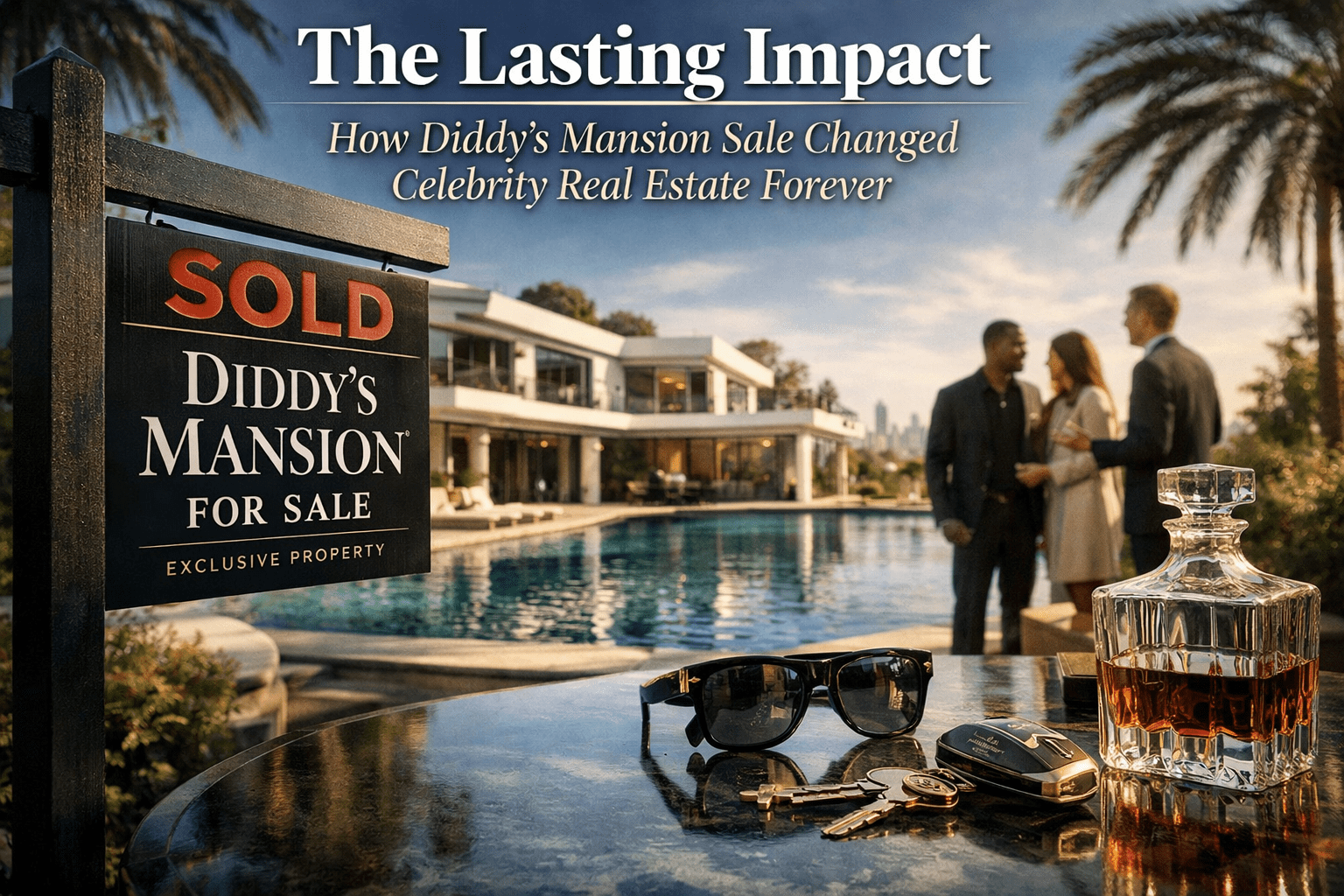
Time has passed since the headlines first echoed through Los Angeles, yet the phrase “Diddy Mansion Sale Stigma” still surfaces whenever experts discuss fame and property. What began as a single listing has become a symbol of how quickly public perception can rewrite market logic.
A Turning Point in Luxury Property History
Before the sale, celebrity homes were seen almost like trophies — proof that fame and fortune always increased a property’s worth. Diddy’s experience flipped that belief. It showed that visibility can both raise and reduce value, depending on how the story around it evolves.
After the controversy, several U.S. agents noticed that buyers were asking fewer questions about who owned a house and more about how it felt to live there. Comfort, calm, and privacy began to outrank public prestige.
This quiet change didn’t just shape how mansions were marketed — it reshaped the philosophy of luxury itself.
Architecture Meets Narrative
Designers and developers began to study how emotional storytelling influences a buyer’s judgment. Diddy’s mansion, once admired for its modern curves and cultural flair, became a case study in how architecture and narrative intertwine.
Today, real-estate consultants in cities like Los Angeles, New York, and Miami often reference this case when teaching new agents:
“Every house has a story. Know when to tell it — and when to let silence raise the value.”
That shift—from celebrity exposure to curated privacy—marked the beginning of a new era in American property culture.
The Ripple Beyond America
Even outside the United States, the story carried weight. In Seoul, Dubai, and London, developers discussed how public image can change international buyer confidence.
For South Korean readers and investors fascinated by Western celebrity culture, the Diddy stigma revealed an important truth: real estate is emotional currency.
A mansion can represent achievement, but if tied to unrest or rumor, its value can tremble overnight.
This understanding led Asian investors to approach U.S. properties with deeper due diligence — not just checking foundations and taxes, but also researching a home’s public reputation.
What It Meant for Celebrities
For Diddy and many of his peers, the mansion sale became a kind of awakening. Wealth and recognition remain powerful, but so does peace of mind.
After the sale, a noticeable number of American celebrities began purchasing properties under private trusts or family names, keeping their addresses confidential. The desire was simple: own without exposure.
The “Diddy Mansion Sale Stigma” had taught them that transparency in fame can sometimes cost privacy — and privacy has become the new symbol of success.
The Public’s Evolving View
Among ordinary Americans, reactions changed over time. What was once gossip slowly turned into understanding.
Many began to see the sale not as a scandal, but as a personal re-set — a human act of letting go.
Fans who once associated luxury only with glamor started recognizing the weight that constant visibility carries. In online discussions, people began describing the event as “the moment fame became too heavy for one address.”
Through that reflection, the stigma transformed into something else: a lesson about balance — between the public dream and private peace.
Legacy in Real Estate Education
Today, real-estate seminars across the U.S. sometimes reference the Diddy case when teaching about perception management, luxury valuation, and market psychology.
It’s cited not as a tragedy, but as an evolution — proof that even multi-million-dollar homes are vulnerable to public emotion.
New brokers learn that storytelling sells homes, but honesty sustains value. Investors learn that cultural energy can shift prices faster than interest rates.
In that way, Diddy’s mansion stigma became a silent chapter in America’s real-estate textbooks.
A Symbol of Reinvention
For Diddy himself, the sale may have closed one door but opened several others.
By stepping away from a house so heavily tied to public opinion, he demonstrated resilience — the ability to move forward even when the spotlight feels harsh.
For many entrepreneurs, artists, and dreamers watching from afar, it became a reminder that reinvention is a form of wealth.
Owning less of what drains you can be worth more than owning everything that defines you.
Conclusion — The Story That Stayed
The Diddy Mansion Sale Stigma will be remembered not only as a real-estate event but as a cultural mirror reflecting America’s complex relationship with fame and fortune.
It taught the market that image is a fragile asset.
It taught audiences that every mansion hides a human story.
And it taught future celebrities that the walls of success can echo louder than applause.
In the end, the mansion wasn’t just sold — it was released.
And in that release, a new understanding of value emerged:
true luxury isn’t what the world sees when you open your gates — it’s what you feel when they finally close.